

Where Does the 80% Statistic on Sleep Problems in Autistic Learners Come From?
Seven studies of sleep problems in autistic children. What each study reported, and what a high score on that questionnaire means.

Editor’s Note
I co-authored “Pediatric Sleep: A Behavioral Account” with Dr. Nicole Rodriguez for the second edition of Madden and DiGennaro-Reed’s APA Handbook of Behavior Analysis (in press, est summer 2027), and I am writing Sleepy Star: A Children’s Book as a Bedtime Aid for Parents (in development) with Dr. Derek Reed. Part of my expertise is in designing evidence-based treatments for behavioral pediatric sleep problems.
As I serve more families, and as I pay closer attention to how pediatric sleep gets discussed, I have heard this statistic: 80% of children with autism have sleep problems. I am typically the person that comes in when a sleep problem passes a certain threshold; I am less familiar with research on prevalence. As such, I wanted to better understand some of the data behind that number.
This post traces the number back to at least some of studies it came from. In a previous post, Dr. Derek Reed looked at what happens to parents when a child is not asleep. In this post, I am looking at the number that gets quoted about children with ASD in the first place, regarding their sleep concerns.
Try it yourself. I tried to create an interactive version of the questionnaire cutoff where you can drag the line and watch the same group of children get reclassified as having or not having a sleep problem. It is a quick way to see how a number like this gets calculated. Open the interactive.
The Gap Is Real
Every study that compared autistic children with a group of other children found the same thing…..more sleep problems in the autism group.
Sleep Problems in Autistic Children and Comparison Children
Four studies that measured both groups with the same instrument in the same sample. Filled bars are autistic children; outlined bars are the comparison group in that study.
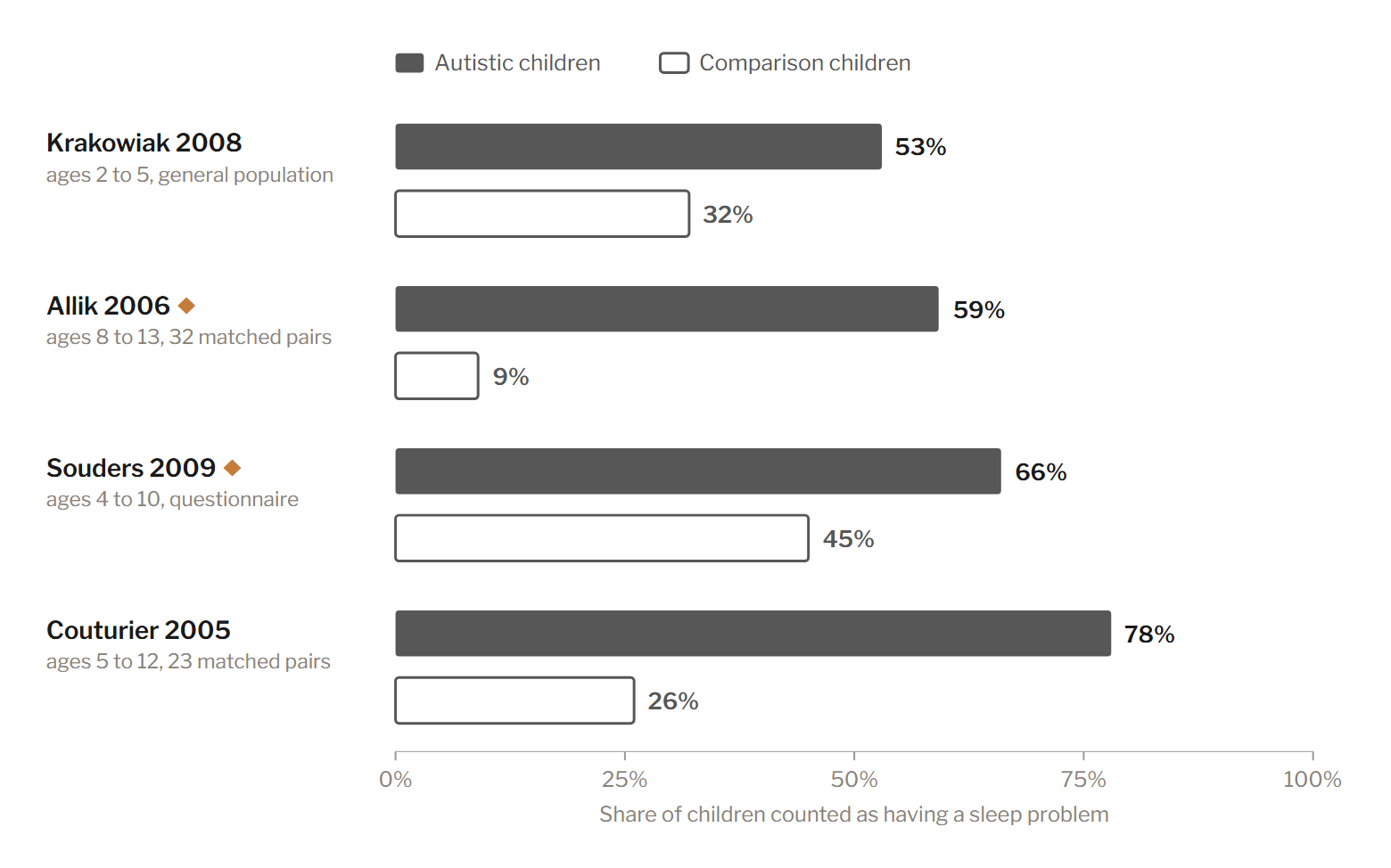
Note. Each study used its own definition and its own comparison group. Therefore, the bars are not interchangeable across studies.
In every study with a comparison group, autistic children were counted as having sleep problems more often, by a factor of roughly one and a half to more than six. That pattern held across three countries, different age ranges, different questionnaires, and different research groups. These differences between groups are clear and have been replicated.
With that said, notice the comparison bars in the figure above. They range from 9% to 45%. Typically developing children, as the comparison group, do not differ that much from one study to the next. The questions asked about them impose such variability. Allik and colleagues (2006) asked parents a single global question about whether their child had a sleep problem. By contrast, Souders and colleagues (2009) counted every child scoring above 41 on a questionnaire.
So Where Did 80% Come From?
What the Studies Reported
Seven of the most-cited studies of sleep problems in autistic children, with the popular “80%” figure marked for reference.
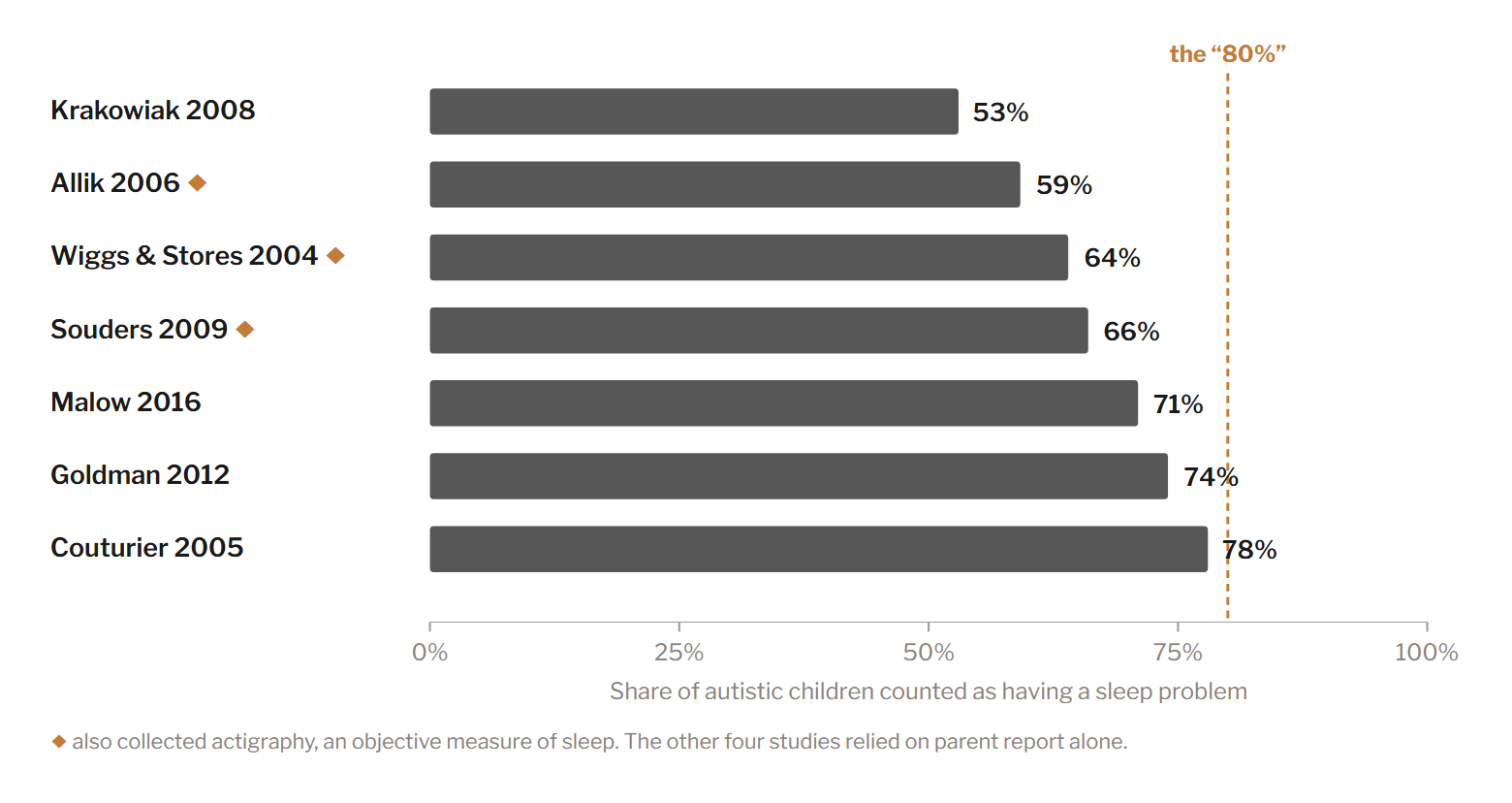
Note. Malow (2016) and Goldman (2012) draw on overlapping samples from the same Autism Treatment Network registry. As such, they are not two independent studies. Each study also defined a sleep problem its own way.
The highest of the seven figures depicted here was 78%, and it came from the study with smallest sample. Couturier and colleagues (2005) analyzed 23 matched pairs of children. Eighteen of those 23 children scored at or above 41. That is where 78% comes from. The 95% confidence interval around that estimate runs from 58% to 90%, meaning the data are consistent with a true rate anywhere in that range.
People typically report ranges when discussing the percentage of autistic children for whom there is a sleep problem. Review articles summarizing the literature describe prevalence as 40% to 80%, or 50% to 80%, or 44% to 83%, and the citation attached is typically one bracket covering many studies at once (e.g., Cortesi et al., 2010; Richdale & Schreck, 2009). The individual studies inside those brackets are the ones charted above. When a range has been linked to specific papers, it is traceable. The Autism Treatment Network’s clinical practice pathway gives 53% to 78% (Malow et al., 2012), and that range comes from exactly two of the studies here, Krakowiak at 53% and Couturier at 78%. Its paired figure for typically developing children, 26% to 32%, comes from the comparison groups in those same two papers.
So the 80% is the top of a range across a set of studies.
What a High Score Means
Four of these seven numbers come from one questionnaire, the Children’s Sleep Habits Questionnaire. A parent rates 45 sleep behaviors by how often each one happened this week: rarely scores 1, sometimes scores 2, usually scores 3. Thirty-three of those items are added into the total score, and a total around 41 gets counted as a sleep problem. Studies split on whether the line sits at 41 or just above it.
Two things about that cutoff are worth knowing if anyone has ever handed you this questionnaire.
First, 41 is a low bar by design. The lowest score a child can possibly get is 33, because even the calmest answer still scores a point. So the line for “has a sleep problem” sits eight points above the floor. Owens and colleagues (2000), who set that cutoff, described the questionnaire as “… designed primarily to be a screening tool” and wrote that it “…should not be used to make definitive sleep disorder diagnoses.” Dr. Nicole Rodriguez and I discuss that distinction in “Pediatric Sleep: A Behavioral Account,” our chapter for the second edition of the APA Handbook of Behavior Analysis.
Second: in the Souders study, that same cutoff flagged 45% of the typically developing comparison children. Those families were neighbors and friends of the autism families, and the authors note that this limits how far the figure generalizes. Owens and colleagues (2000) offer a cleaner anchor from their community sample, where a score above 41 captured the upper 23% of children. Regardless, a cutoff that flags somewhere between a quarter and a half of children without autism is not identifying a sleep disorder.
The Same Children but Evaluated in Different Ways
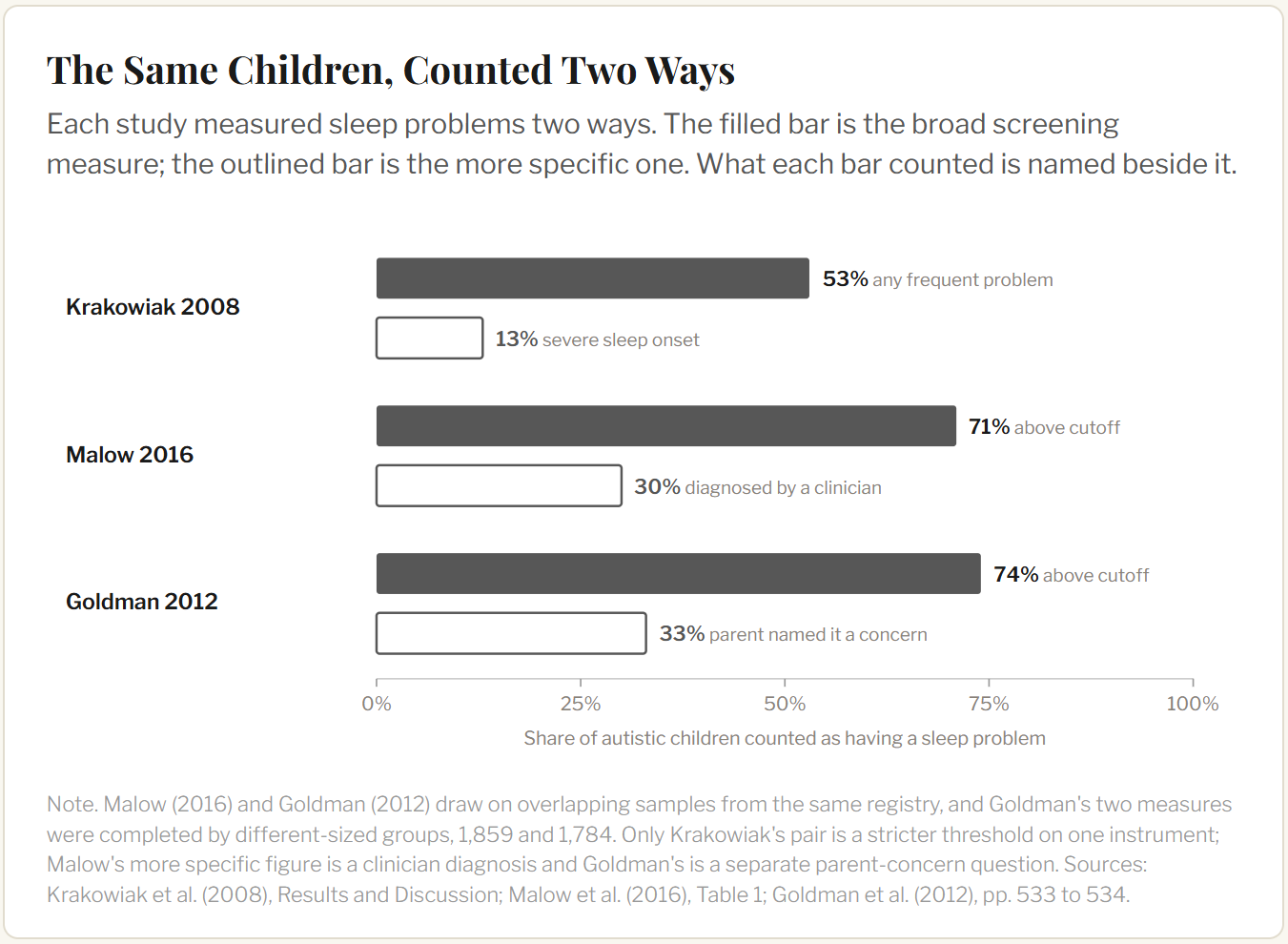
Each of these studies produced a different number depending on how the study counted a sleep problem. Krakowiak and colleagues (2008) found that 53% of autistic children had at least one frequent sleep problem; when the same children were held to a severity threshold for sleep-onset problems, 13% met it. In Malow and colleagues’ registry study of 1,518 children, 71% scored at or above the questionnaire cutoff but only 30% received a sleep diagnosis from a clinician. The research team behind that study wrote that the cutoff of 41 “may be too low for use in ASD, especially in younger children” (Malow et al., 2016).
A note on the charts. The three figures above were built from the data tables and text in the source papers. These specific figures do not appear in the source papers; the underlying numbers do. They were rebuilt to show the pattern in one view.
Take-Home Points
Sleep concerns appear more common among autistic learners. Every study here that included a comparison group found more sleep problems in the ASD group. Taking an hour to fall asleep or being up for the day at 5 a.m. are all reported more often for autistic children than for their peers.
No single study in this set reported 80%. The figures ranged from 53% to 78%. The 80% appears in review articles as the top of a range rather than as anything a study measured, so consider always reporting the range. That range also matches what the Autism Treatment Network’s practice pathway gives (Malow et al., 2012).
A prevalence number makes the case for screening autistic learners for potential sleep concerns. If you work with children who have been diagnosed with autism, asking about sleep should be routine. A high score on a sleep questionnaire is a reason to look closer; it is not a diagnosis. Nearly half the typically developing children in one study cleared the same cutoff. Clearing the cutoff still matters. It signals that further investigation is warranted and more information should be gathered from the family. That is, a more formal assessment of the extent to which the sleep problem is interfering with the child’s functioning and with the family’s functioning should be the next step.There is an interactive version of the questionnaire cutoff where you can drag the line and watch the same group of children get reclassified as having or not having a sleep problem. It is a quick way to see how a number like this gets made.
Try it yourself. I tried to create an interactive version of the questionnaire cutoff where you can drag the line and watch the same group of children get reclassified as having or not having a sleep problem. It is a quick way to see how a number like this gets calculated. Open the interactive.
References
Allik, H., Larsson, J.-O., & Smedje, H. (2006). Sleep patterns of school-age children with Asperger syndrome or high-functioning autism. Journal of Autism and Developmental Disorders, 36(5), 585–595. https://doi.org/10.1007/s10803-006-0099-9
Cortesi, F., Giannotti, F., Ivanenko, A., & Johnson, K. (2010). Sleep in children with autistic spectrum disorder. Sleep Medicine, 11(7), 659–664. https://doi.org/10.1016/j.sleep.2010.01.010
Couturier, J. L., Speechley, K. N., Steele, M., Norman, R., Stringer, B., & Nicolson, R. (2005). Parental perception of sleep problems in children of normal intelligence with pervasive developmental disorders: Prevalence, severity, and pattern. Journal of the American Academy of Child & Adolescent Psychiatry, 44(8), 815–822. https://doi.org/10.1097/01.chi.0000166377.22651.87
Goldman, S. E., Richdale, A. L., Clemons, T., & Malow, B. A. (2012). Parental sleep concerns in autism spectrum disorders: Variations from childhood to adolescence. Journal of Autism and Developmental Disorders, 42(4), 531–538. https://doi.org/10.1007/s10803-011-1270-5
Krakowiak, P., Goodlin-Jones, B., Hertz-Picciotto, I., Croen, L. A., & Hansen, R. L. (2008). Sleep problems in children with autism spectrum disorders, developmental delays, and typical development: A population-based study. Journal of Sleep Research, 17(2), 197–206. https://doi.org/10.1111/j.1365-2869.2008.00650.x
Malow, B. A., Byars, K., Johnson, K., Weiss, S., Bernal, P., Goldman, S. E., Panzer, R., Coury, D. L., & Glaze, D. G. (2012). A practice pathway for the identification, evaluation, and management of insomnia in children and adolescents with autism spectrum disorders. Pediatrics, 130(Suppl. 2), S106–S124. https://doi.org/10.1542/peds.2012-0900I
Malow, B. A., Katz, T., Reynolds, A. M., Shui, A., Carno, M., Connolly, H. V., Coury, D., & Bennett, A. E. (2016). Sleep difficulties and medications in children with autism spectrum disorders: A registry study. Pediatrics, 137(Suppl. 2), S98–S104. https://doi.org/10.1542/peds.2015-2851H
Owens, J. A., Spirito, A., & McGuinn, M. (2000). The Children’s Sleep Habits Questionnaire (CSHQ): Psychometric properties of a survey instrument for school-aged children. Sleep, 23(8), 1043–1051.
Souders, M. C., Mason, T. B. A., Valladares, O., Bucan, M., Levy, S. E., Mandell, D. S., Weaver, T. E., & Pinto-Martin, J. (2009). Sleep behaviors and sleep quality in children with autism spectrum disorders. Sleep, 32(12), 1566–1578. https://doi.org/10.1093/sleep/32.12.1566
Wiggs, L., & Stores, G. (2004). Sleep patterns and sleep disorders in children with autistic spectrum disorders: Insights using parent report and actigraphy. Developmental Medicine & Child Neurology, 46(6), 372–380. https://doi.org/10.1017/S0012162204000611
Dr. Kevin Luczynski and Dr. Derek Reed are behavioral scientists helping families with sleep, challenging behavior, and more. They are co-authoring Sleepy Star: A Children’s Book as a Bedtime Aid for Parents. Subscribe to Atomic Parenting for sleep science and behavioral parenting.