

When Your Kid Doesn’t Sleep, Neither Do You
The quiet epidemic of parent sleep loss, and why it hits some families twice as hard.

Photo by Kinga Howard on Unsplash
If you’re reading this at 2 a.m. with one ear open for footsteps in the hall, here’s what I want you to know up front: you’re not imagining how tired you are, and you’re not failing at something other parents have figured out.
We treat parent sleep deprivation as a punchline, like it’s a rite of passage you survive and don’t talk about. But there’s a legit body of research behind it, and the picture is sobering. Parents in chronic sleep debt are walking around in roughly the same cognitive state as people who’d be pulled over for impaired driving. When kids sleep poorly, parents almost always do too. And for families raising children with autism or other neurodevelopmental differences, that effect is amplified.
Three studies, one story
Australian researchers surveyed over 10,000 families (Martin et al., 2007). When an infant had serious sleep problems, the mother’s risk of psychological distress roughly doubled (read that again: DOUBLED). So did her chances of poor general health. Fathers weren’t spared either; their risk of poor health went up about 50 percent.
An American study (Lopez-Wagner et al., 2008) compared families raising children with autism to other families. Parents in the autism group scored about 40 percent worse on overall sleep quality. And here’s the important takeaway: it wasn’t the severity of the child’s autism that predicted how badly parents slept. It was the child’s sleep problems.
An Irish study of 409 parents of children with autism (Mannion & Leader, 2023) found that nearly nine in ten met the clinical threshold for poor sleep. Among those whose children had sleep problems, almost half had clinically significant anxiety. Stress was higher, quality of life lower across the board.
What that exhaustion is actually doing
Research by Williamson and Feyer (2000) found that after about 17–19 hours awake, people perform on attention and reaction-time tasks at the same level as someone at the legal blood alcohol limit. Push the sleep loss further, and performance drops into DUI-equivalent territory.
Think about what that means: If your kid wakes you at 1 a.m. and you can’t fall back asleep, by breakfast, you’re cognitively impaired at a level the law says is too dangerous to drive. And that’s ONE bad night. Chronic partial sleep loss—the kind that just becomes life for a lot of us—is probably worse.
Now let’s extrapolate this a bit more. You are exhausted at the breakfast table. Your child does something that could be a teaching moment, but you react impatiently. And then your child does something that you’d typically want to reinforce or praise, but you miss it because your cognitive processing is stunted from sleep deprivation. This vicious cycle can lead to more behavior problems and less effective parenting, which just exacerbates the household stress and even the likelihood of quality sleep that night. And it happens again, and again, and again.
These findings reframe a lot. The version of you that snaps over the dishwasher or loses patience with your kid’s fourth bedtime request isn’t some hidden truth about your character. It’s simply a legitimate parenting impairment. You give loved ones a pass when they misspeak or make innocent mistakes when they’re impaired. Show yourself the same courtesy: Be slow to judge yourself by what you said at 11 p.m. after months of broken sleep.
What that looks like in a chart
Here’s the comparison from the American study. Higher scores mean worse sleep.
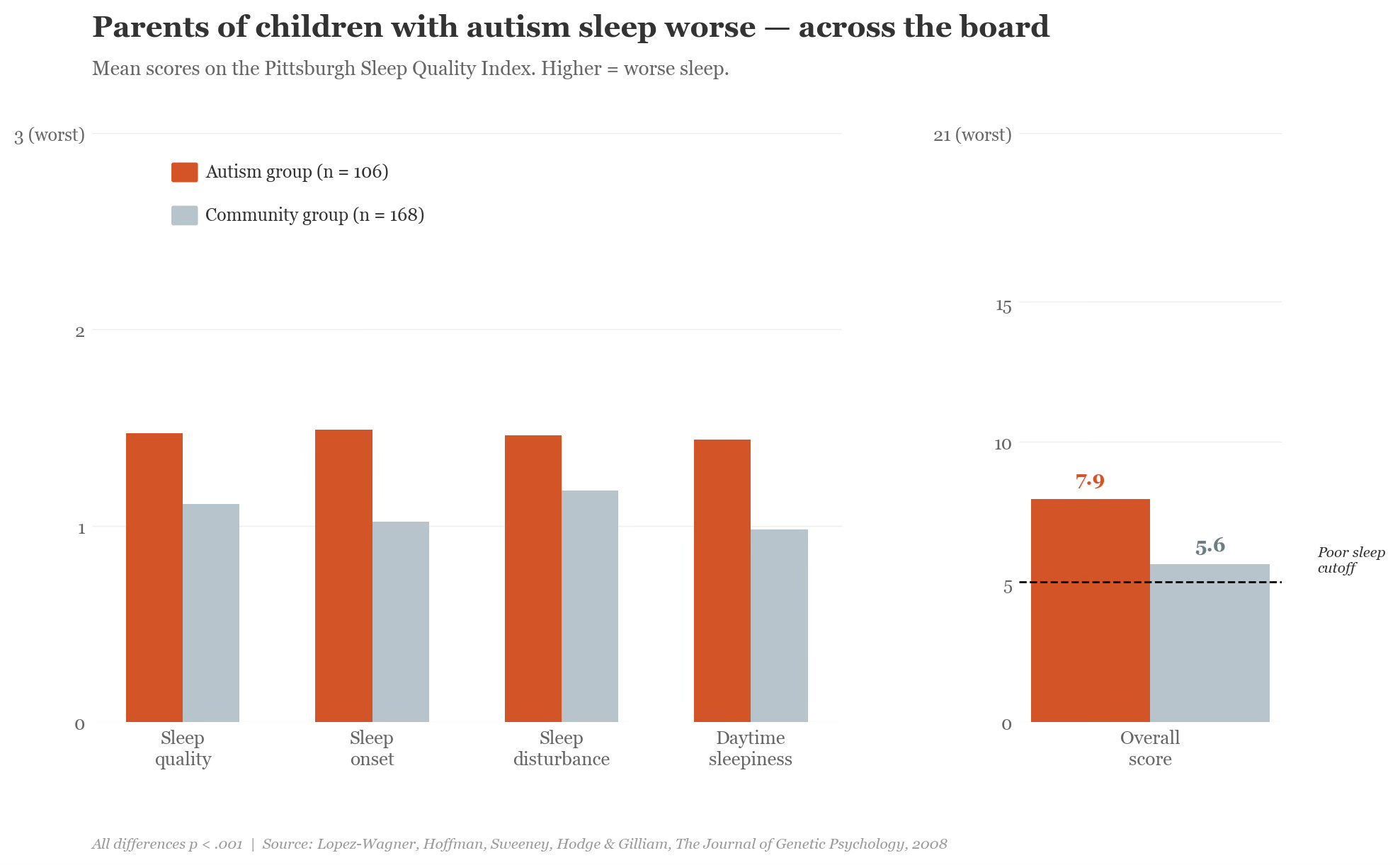
[Chart 1: Bar chart comparing parent sleep scores between autism and community groups across five sleep dimensions — Sleep Quality, Sleep Onset, Sleep Disturbance, Daytime Sleepiness, and overall sleep quality. Data from Lopez-Wagner et al., 2008, Table 2.]
And here’s what that translates into downstream:
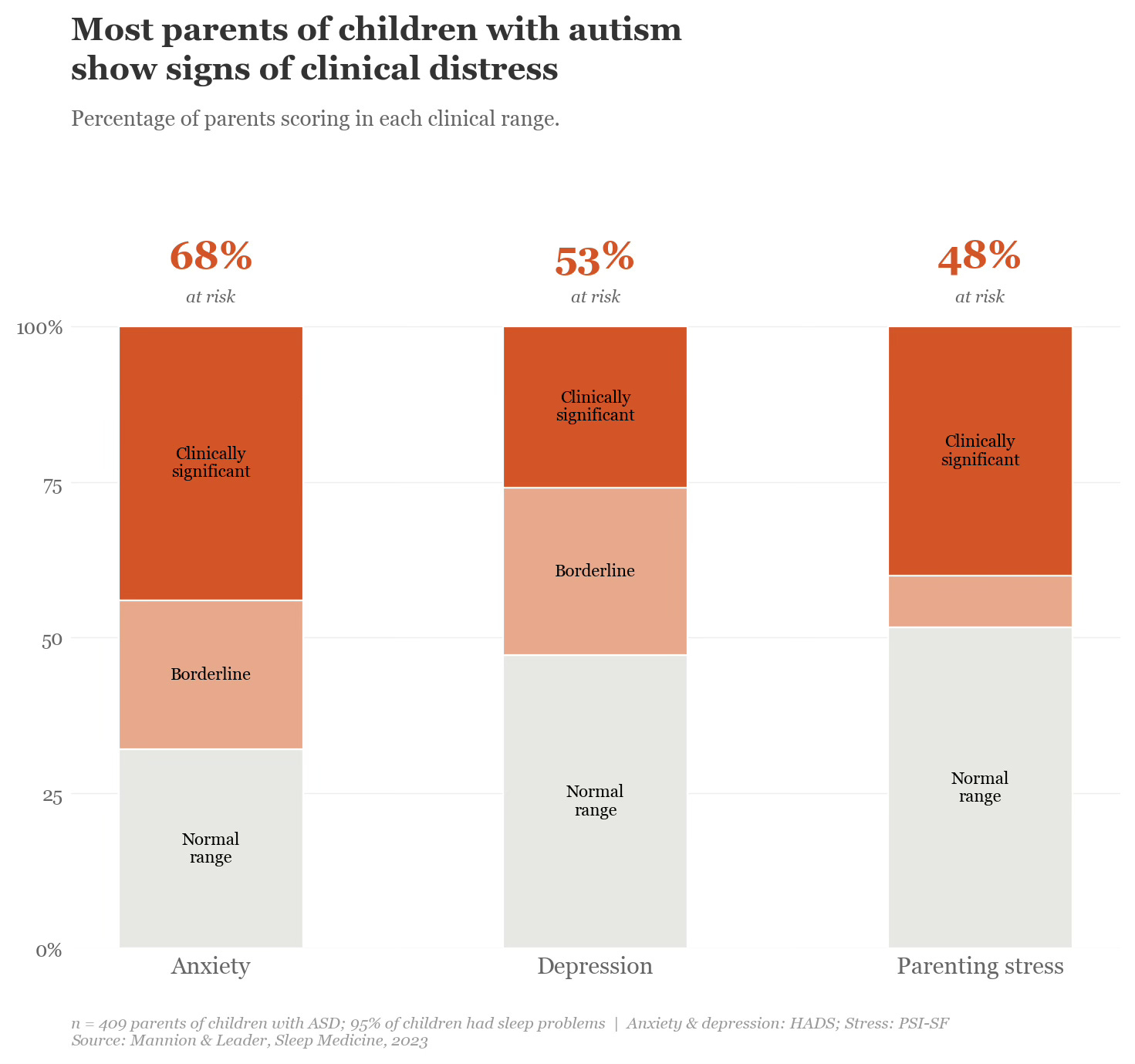
[Chart 2: Bar chart showing the percentage of parents in the abnormal or clinically significant range for anxiety, depression, and parenting stress, split by whether the child had sleep problems. Data from Mannion & Leader, 2023.]
Why this matters more than we admit
The standard line is that parent exhaustion is temporary: survive the early baby years, and things “normalize.” For many families, that’s true. For families raising children with autism, the story is way different. Earlier research found that sleep problems persisted in over 90 percent of children with autism across two years. This means that sleep disruption isn’t a phase you can just wait out.
The reasons for this are straightforward. If a child takes forever to fall asleep, the parent waits up. This displaces the parent’s nighttime routines and causes a later bedtime than usual. If the child wakes repeatedly, the parent’s sleep fractures. And then the child awakes at their normal time, but this means the parent’s sleep is shorter. Studies confirm parents’ and children’s sleep patterns move in lockstep (if you’re one of these parents, you absolutely know what I’m talking about!). One trial (perhaps unsurprisingly) showed that treating the child’s sleep problem measurably improved the mother’s mood. Helping the child helped the parent. This is helpful information that can guide the ways we treat families’ sleep issues moving forward. The sleep cycle is a household system—not one family member’s medical issue.
What I want you to take from this
If you’re exhausted because your child doesn’t sleep well, you are experiencing something well-documented and common. You’re not a weaker parent than the ones who look rested … you may just have a child whose sleep is harder. In the autism and ADHD communities, what you’re going through is close to universal.
When a clinician addresses your child’s sleep, they’re also (whether they name it or not, or even know it or not) treating the parents’ mental and physical health, as well as their relationship. If you’ve been hesitant to bring up sleep because it feels small next to everything else on the list, this is your permission slip. It’s not small. And your own sleep belongs in that conversation too. Dads especially tend to get missed here: if you’re a father reading this, you count in this equation, too!
Fellow tired parents: go easy on yourself tonight. You’re doing the best you can do under the circumstances!
Studies referenced:
Mannion, A., & Leader, G. (2023). Relationship between child sleep problems in autism spectrum disorder and parent mental health and well-being. Sleep Medicine, 109, 4–10.
Lopez-Wagner, M. C., Hoffman, C. D., Sweeney, D. P., Hodge, D., & Gilliam, J. E. (2008). Sleep problems of parents of typically developing children and parents of children with autism. The Journal of Genetic Psychology, 169(3), 245–259.
Martin, J., Hiscock, H., Hardy, P., Davey, B., & Wake, M. (2007). Adverse associations of infant and child sleep problems and parent health: An Australian population study. Pediatrics, 119(5), 947–955.
Williamson, A. M., & Feyer, A.-M. (2000). Moderate sleep deprivation produces impairments in cognitive and motor performance equivalent to legally prescribed levels of alcohol intoxication. Occupational and Environmental Medicine, 57(10), 649–655.