

Within China, Where Your Child Lives Shapes When They Sleep
Wu et al. (2018) · Journal of Clinical Sleep Medicine - A population-based study of 1,610 Chinese preschoolers across 10 cities.

As a behavioral scientist, I read pediatric sleep research to better understand what factors can influence sleep. I am reading articles beyond those related to assessment and treatment. The Wu et al. (2018) paper caught my attention due to sleeping differences between regions captured within the same country.
In a previous post, I looked at how pediatric sleep varies across countries (Mindell et al., 2010, 2013). In this post, I look at how those differences show up within one country.
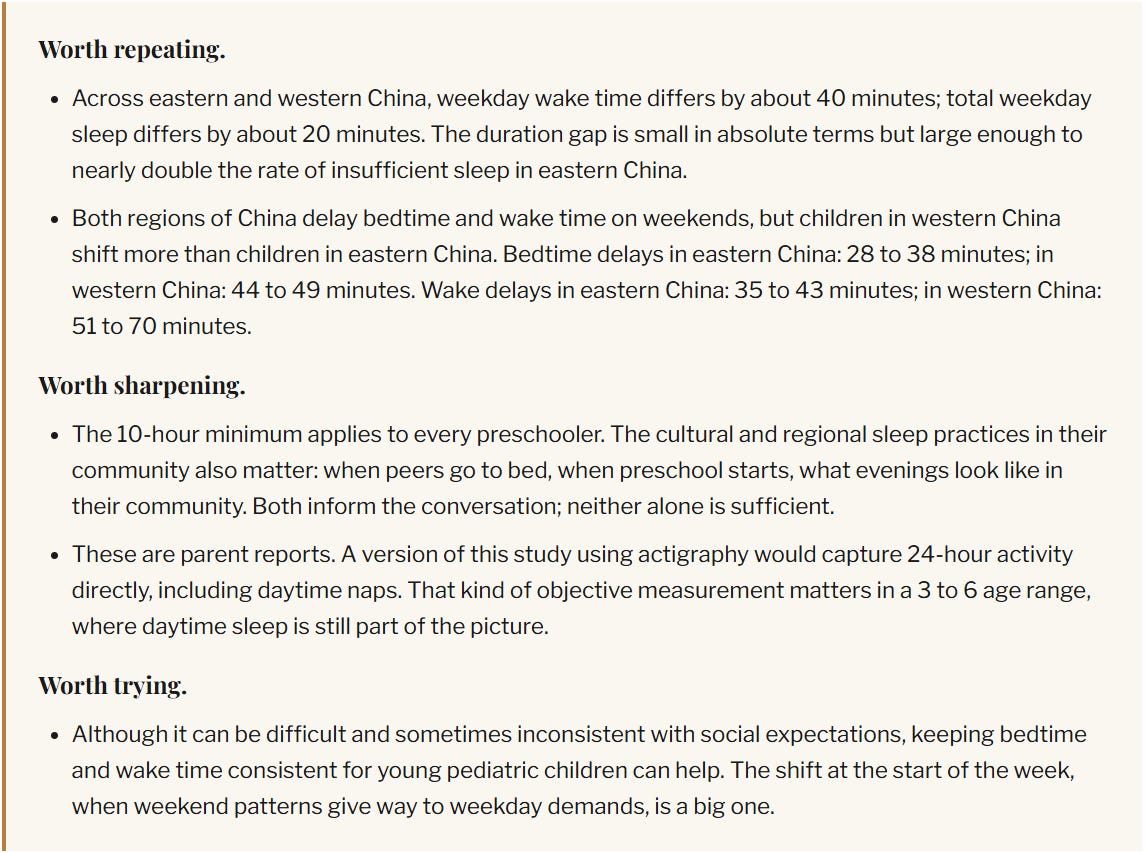
Within China, what counts as a typical bedtime, wake time, and amount of sleep shifts by nearly an hour from one region to another. As such, it is important to talk with each family about what is typical for their region, not the national average.
A 4.5-year-old in China wakes at 7:30 AM. In one province, that is among the earliest wake times in her class. In another, it is among the latest. Both children live on the same Beijing clock and follow the same national sleep recommendations.
In eastern China, 16.9% of preschoolers slept less than the 10-hour minimum. In western China, 9.3% did not meet the same criterion. Same country, same threshold, nearly twice the rate of insufficient sleep in one region.
Wu et al. (2018) collected parent reports on 1,610 Chinese preschoolers, ages 3 to 6, across 10 cities, from November 2012 through January 2013. They split the sample by time zone: 1,201 children in eastern China (UTC+8, on Beijing time, the wealthier eastern coast including Shanghai and Beijing) and 409 children in western China (UTC+7 and UTC+6, including Xinjiang and Tibet). Sleep variables were measured using questions adapted from the Children’s Sleep Habits Questionnaire.
The five figures below were built from data tables in the Wu paper. These exact figures do not appear in the source paper.
In the United States and across much of the Western literature, lower-income neighborhoods are associated with shorter sleep in children. In China, the wealthier and more developed eastern provinces are the ones whose children sleep less. Wu et al. speculated that evening academic tutoring, screen time, and competition for primary-school admission were associated with the differences across regions.
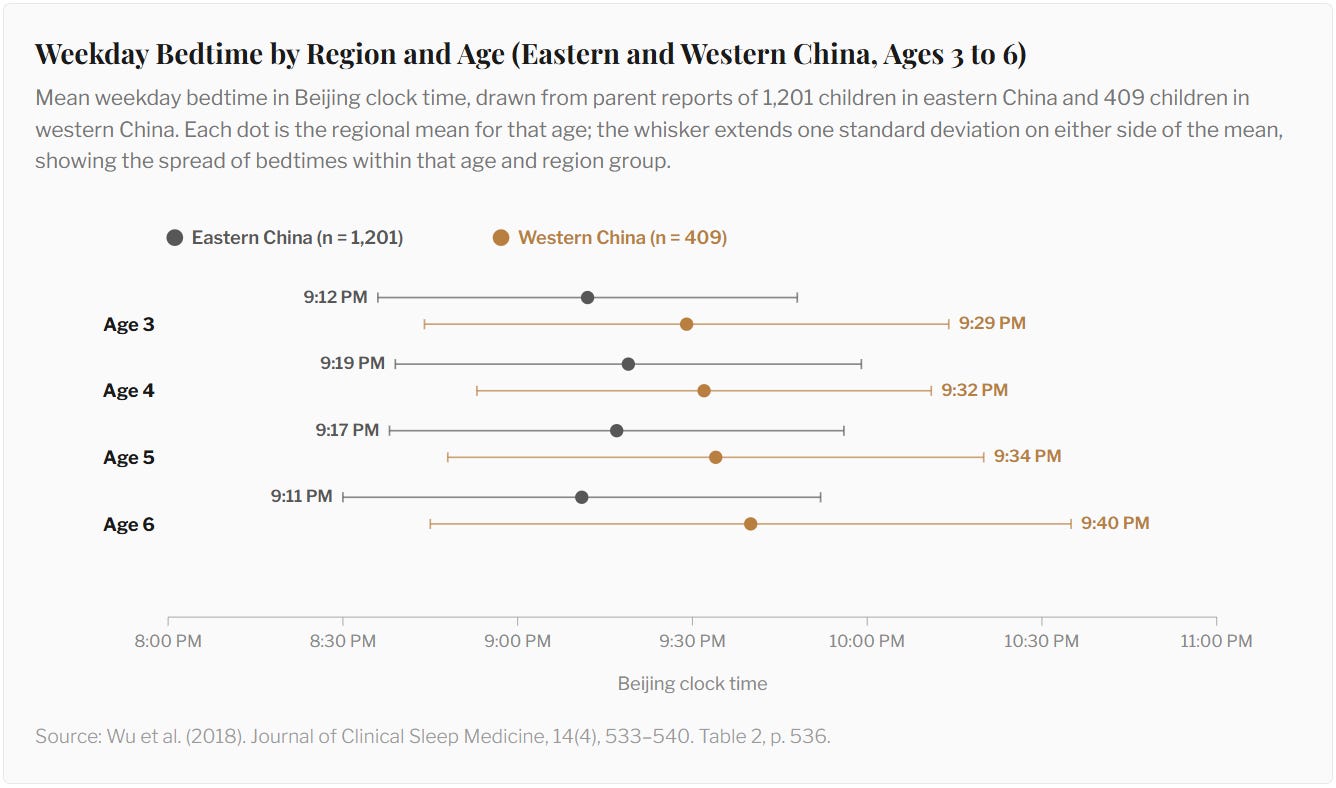
Data in the figure above represent the mean bedtime, in Beijing clock time, on weeknights, by region and age. Children in eastern China went to bed about 20 minutes earlier than children in western China across the four ages, and the spread of bedtimes within each region (the whiskers) overlapped considerably. The bedtime gap was small but consistent.
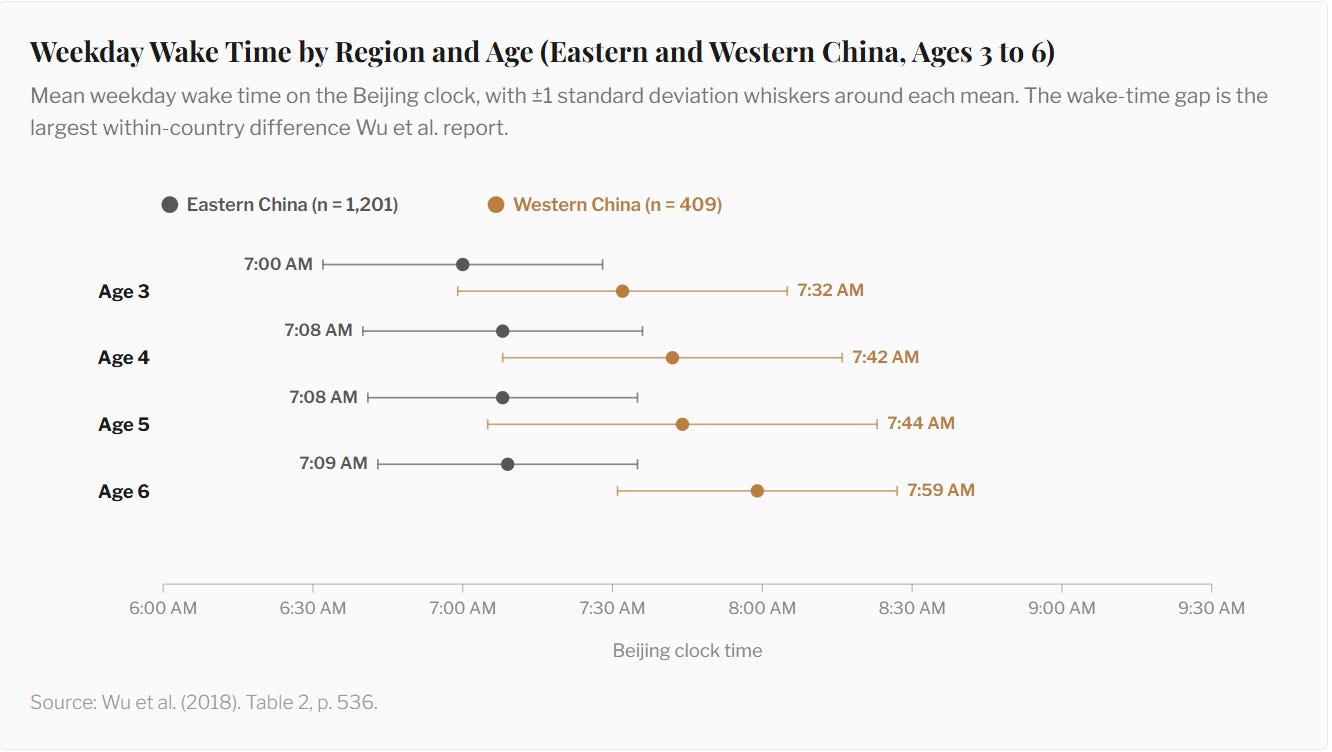
Data in the figure above represent the average wake time, in Beijing clock time, on weekday mornings, by region and age. The wake-time gap was much larger than the bedtime gap. Children in eastern China awoke about 40 minutes earlier than children in western China, and within each region the spread was reasonably tight, around 28 minutes on either side of the mean. In standardized terms (Cohen's d = 1.24), this is the largest within-country effect Wu et al. report.
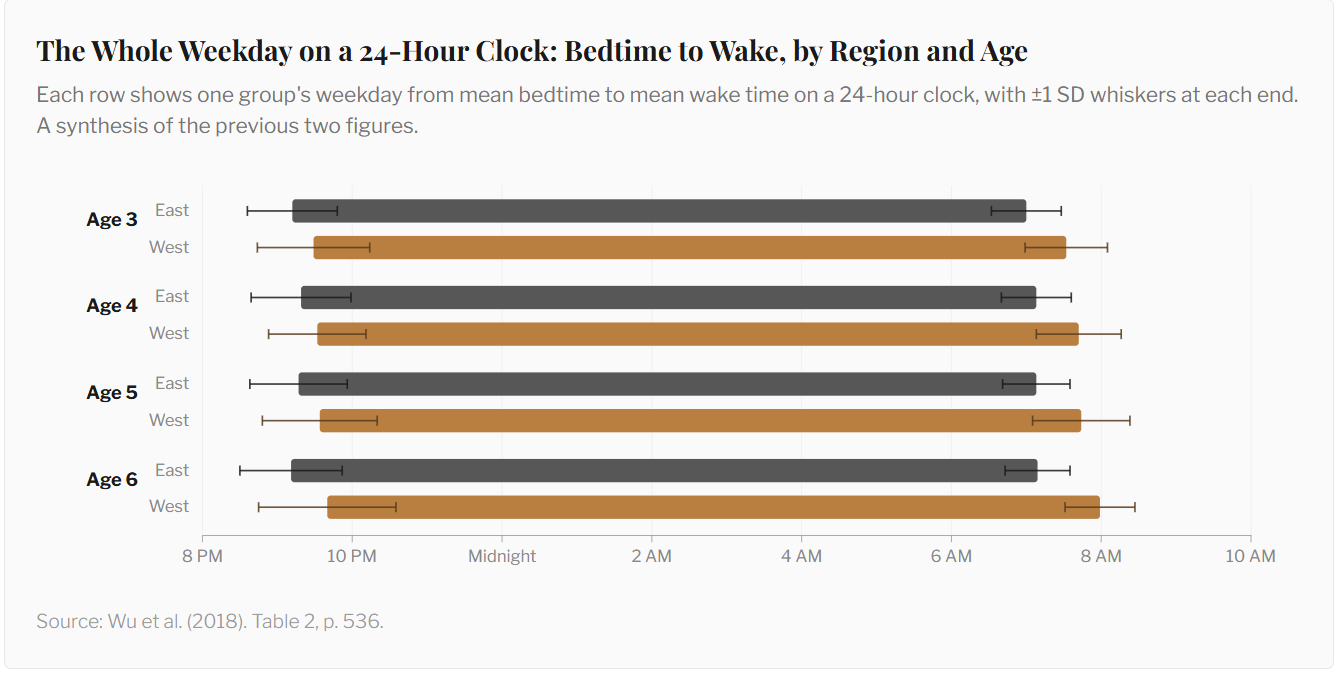
Data in the figure above show each region's full weekday sleep window, age by age, on a single 24-hour clock. The eastern-China band sits earlier; the western-China band sits later. The two bedtimes are close, but the wake times are clearly displaced. Across the four ages, the east-to-west gap within China was consistent.
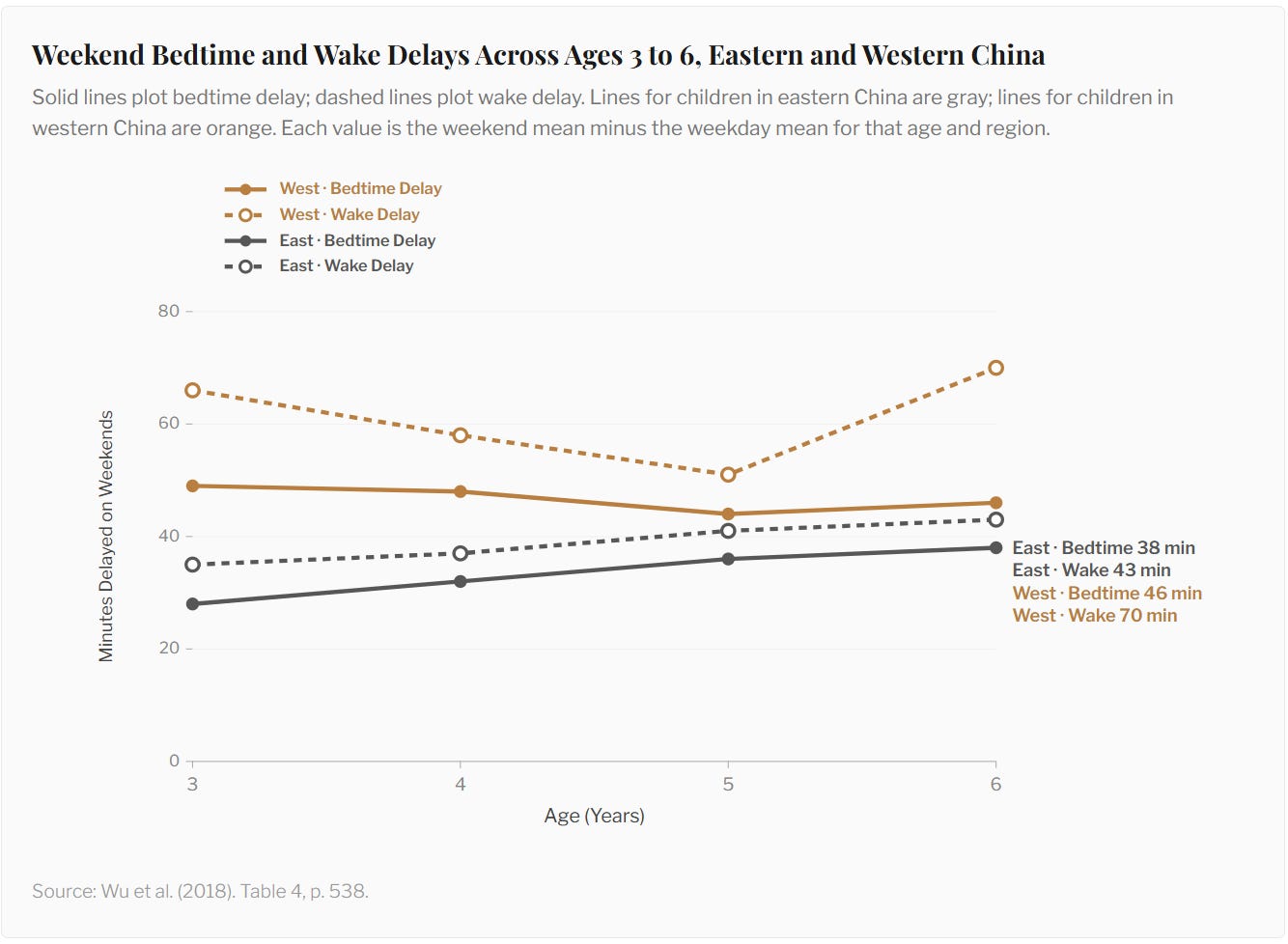
Data in the figure above represent how many minutes later children went to bed and woke up on weekends than on weekdays, by region and age. Both regions showed a delayed bedtime and wake time; western China slides further at both ends. The wake delay in western China (the dashed orange line) sits at the top of the chart at every age, with the bedtime delay in western China just below it. The wake delay and bedtime delay in eastern China sit clustered together at the bottom. The western-China lines stay roughly 10 to 30 minutes above the eastern-China lines across the full four-year age range.
Wu et al. attributed the shortfall in sleep in eastern China to a specific stack of evening pressures, in their words (pp. 537–538):
"For example, children in eastern China are more likely to participate in mathematics tutoring, piano lessons, and other extracurricular activities at night in order to gain entry to a better primary school. Digital technology use is more popular among children in eastern China." Wu et al., 2018, p. 538
From a behavioral perspective, the question is what fills the evening in each region. Children in eastern China are not sleeping as much due to their delayed bedtime. Math tutoring, piano lessons, and screen time may push the bedtime hour later in the wealthier provinces. Children in western China, whose families face less competitive primary-school pressure, more often have earlier bedtimes
Wu et al. closed their paper with a recommendation for parents and policy:
"It is recommended that parents in China allow and support their children to get enough sleep according to the recommended NSF sleep time through the maintenance of a stable sleep pattern throughout the week, in order to avoid misalignment." Wu et al., 2018, p. 539
What counts as early or late, and what counts as enough sleep, depends on where in China a child lives, how far local solar time runs from Beijing time, and what evening practices are common in their region. Every conversation about a child’s sleep should begin with the family’s actual bedtime, wake time, and the activities that fill their evenings. The national average is a reference point, not the schedule the child experiences each night.
References
Hirshkowitz, M., Whiton, K., Albert, S. M., Alessi, C., Bruni, O., DonCarlos, L., Hazen, N., Herman, J., Katz, E. S., Kheirandish-Gozal, L., Neubauer, D. N., O’Donnell, A. E., Ohayon, M., Peever, J., Rawding, R., Sachdeva, R. C., Setters, B., Vitiello, M. V., Ware, J. C., & Adams Hillard, P. J. (2015). National Sleep Foundation’s sleep time duration recommendations: Methodology and results summary. Sleep Health, 1(1), 40–43. https://doi.org/10.1016/j.sleh.2014.12.010
Mindell, J. A., Sadeh, A., Wiegand, B., How, T. H., & Goh, D. Y. T. (2010). Cross-cultural differences in infant and toddler sleep. Sleep Medicine, 11(3), 274–280. https://doi.org/10.1016/j.sleep.2009.04.012
Mindell, J. A., Sadeh, A., Kwon, R., & Goh, D. Y. T. (2013). Cross-cultural differences in the sleep of preschool children. Sleep Medicine, 14(12), 1283–1289. https://doi.org/10.1016/j.sleep.2013.09.002
Paruthi, S., Brooks, L. J., D’Ambrosio, C., Hall, W. A., Kotagal, S., Lloyd, R. M., Malow, B. A., Maski, K., Nichols, C., Quan, S. F., Rosen, C. L., Troester, M. M., & Wise, M. S. (2016). Recommended amount of sleep for pediatric populations: A consensus statement of the American Academy of Sleep Medicine. Journal of Clinical Sleep Medicine, 12(6), 785–786. https://doi.org/10.5664/jcsm.5866
Wu, R., Wang, G.-H., Zhu, H., Jiang, F., & Jiang, C.-L. (2018). Sleep patterns in Chinese preschool children: A population-based study. Journal of Clinical Sleep Medicine, 14(4), 533–540. https://doi.org/10.5664/jcsm.7038