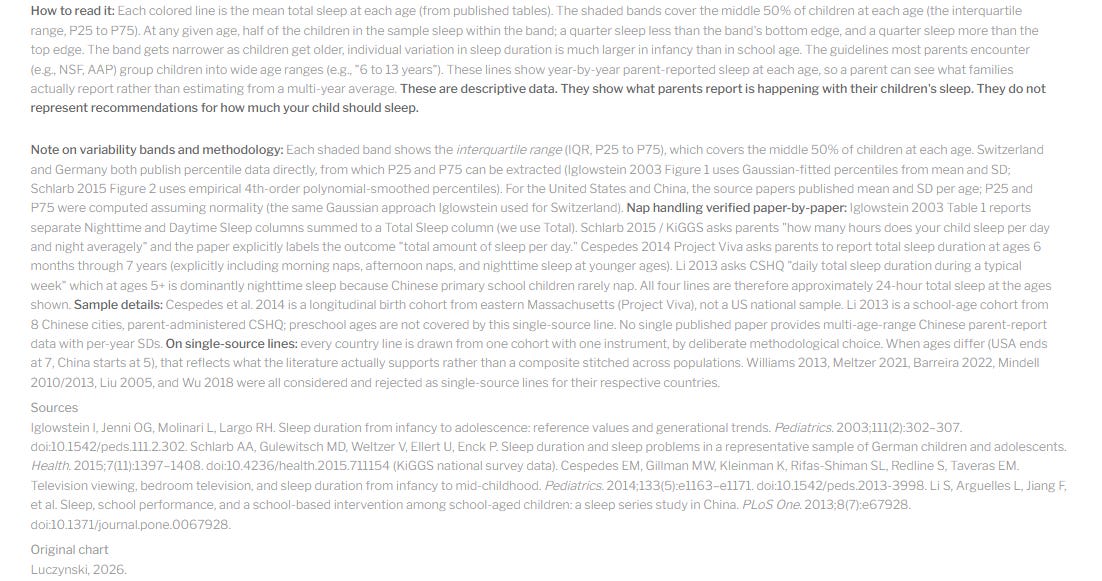
How Much Children Sleep Based on Parental Reports Across Four Countries
SLEEP SCIENCE: Pediatric sleep - awareness, assessment, and treatment

In clinical practice, I focus on applying practical assessment and intervention approaches. I will share my experiences on those in the future. For now, I am looking at what sleep looks like across cultures and countries.
In a previous post, I re-graphed data from the National Sleep Foundation’s 2026 survey of North American families alongside sleep guidelines from the National Sleep Foundation and the American Academy of Sleep Medicine. One implication for practice is that more awareness of the recommended total sleep durations is warranted, which could inform the timing of children’s bedtime. You can toggle on and off the different studies in the visual here.
As I have continued to look at research on sleep timing and duration of children, I noticed parent-reported sleep durations published by research teams from different countries. I was interested in studies that provide fine-grained, parent-reported sleep duration data in 1-year or 1.5-year intervals rather than aggregating across wide age bands (e.g., 3 to 5 year olds, 6 to 13 year olds). Below is a visual I created comparing data from four studies of families in the USA, Switzerland, Germany, and China.
You can toggle off and on the mean data from each country as well as the variability bands in the interactive graphical depiction here.
Please remember these data are reported by parents. These data do not capture how much children are sleeping based on objective measures and how much children should be sleeping.
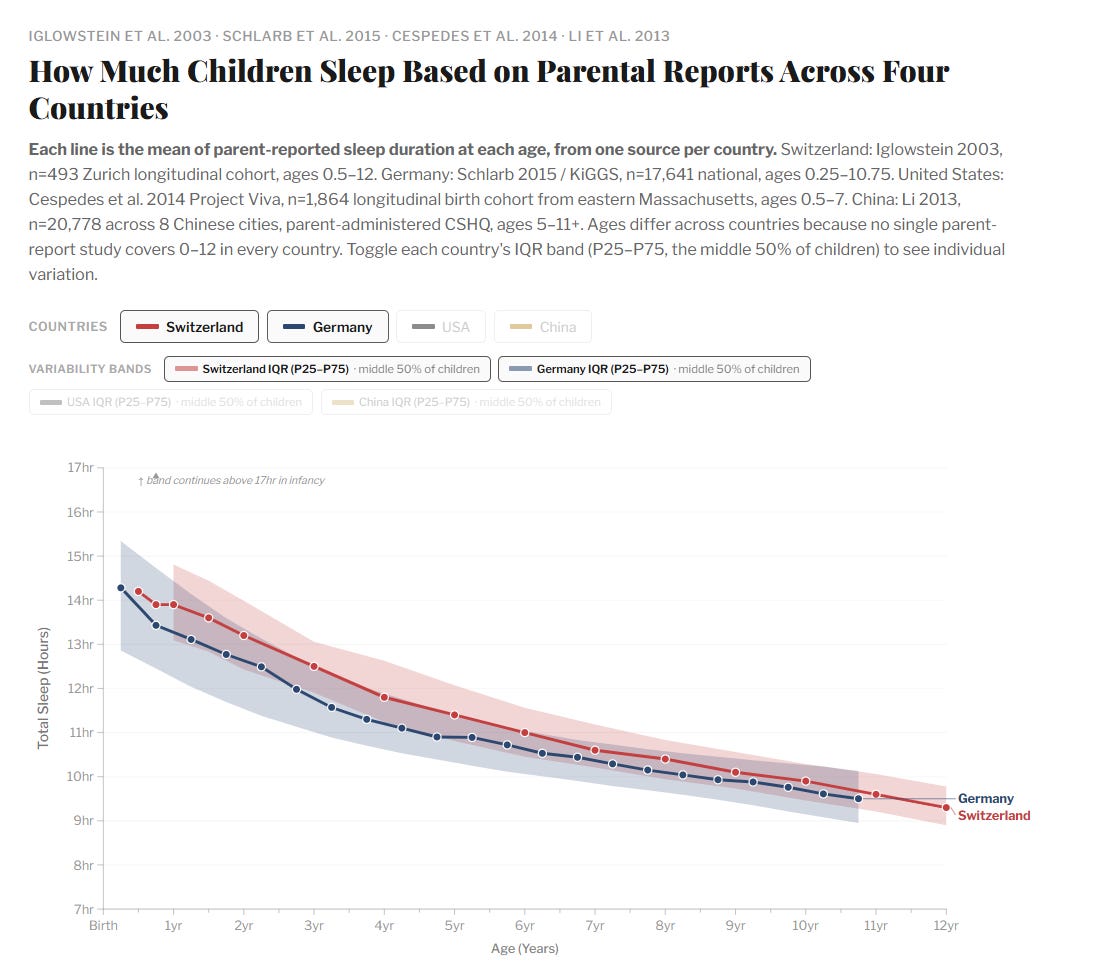
Above are data from Iglowstein and colleagues (2003; Switzerland) and Schlarb and colleagues (2015; Germany). The lines represent means; the bands represent the 25th to 75th percentile (50% of children). Swiss children slept 30 to 50 min longer than German children from about age 1 to age 6. The Iglowstein et al. cohorts were born between 1974 and 1993, which is 10 to 30 years before the other three studies collected their data. It is plausible that the sleep durations of Swiss children have decreased since the study was conducted, which would be consistent with a trend of later bedtimes and relatively unchanged wake times observed across the Swiss cohorts in the Iglowstein study.
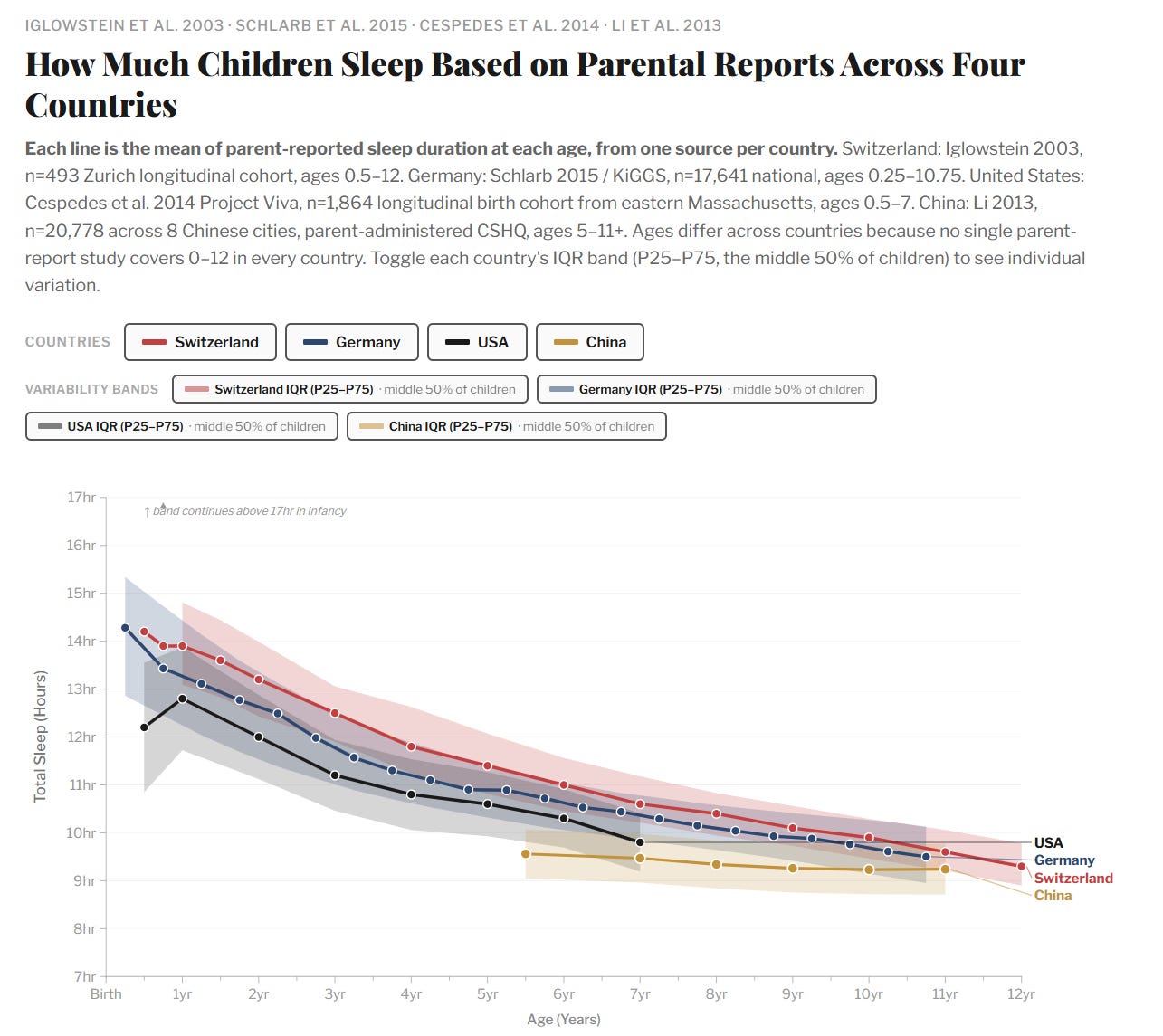
Above are additional data from a Massachusetts (USA) cohort and Chinese families as obtained by Cespedes and colleagues (2014) and Li and colleagues (2013), respectively. On average, North American children slept less than German and Swiss children. Children in China slept the least for older age ranges.
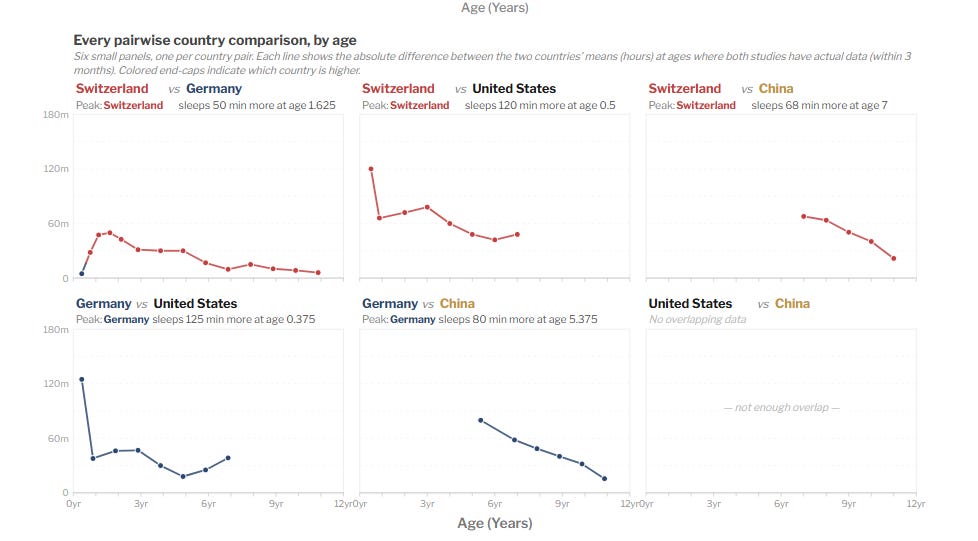
The graph above shows pairwise differences between countries at each age. For example, German children slept more than American children across all overlapping ages, as indicated by the blue data points in the bottom left panel.
These data are descriptive, and there are differences in when and how these data were obtained. How much children sleep varies considerably depending on where and when children are raised. Cultural practices around bedtime (e.g., finishing academic work, later mealtimes, screen use near bedtime) and wake times likely contribute to these differences. This will be explored more in the future.