

Do You Know How Common Pediatric Bedtime Routines Are Across Cultures and the World? [I didn't]
Bedtime Routines: Prevalence

Editor’s Note: I co-authored “Pediatric Sleep: A Behavioral Account” with Dr. Nicole Rodriguez for the second edition of Madden and DiGennaro-Reed’s APA Handbook of Behavior Analysis (in press), and I am writing Sleepy Star (in development), a children’s book as as bedtime aid for parents, with Dr. Derek Reed. Between the chapter, the book, and my clinical work with families, I have been been reading scientific articles and popular-press pieces about pediatric sleep. Some of these posts re-imagine data from published studies into graphical depictions to tell the same story in a different way.
I was born in the southwest suburbs of Chicago to second-generation parents from Germany and Poland. Based on my experience, I thought everybody had consistent bedtime routines and bedtimes. If you had asked me whether a hundred other families had bedtime routines, I would have confidently answered in the affirmative without hesitation. As a consultant who provides personalized services to families and contributes to the literature on the assessment and treatment of pediatric sleep concerns, I had no idea of the extent to which bedtime routines are common in North America, or whether bedtime routines are similar across cultures and geography (i.e., the world).
I found several studies and reimagined graphical depictions of their data to tell a visual story of the prevalence of bedtime routines.
As a reminder, I have mostly read and participated in research related to the assessment and treatment of problems at the level of individual families and children. I am less familiar with studies capturing global aspects of sleep, such as the prevalence of bedtime routines.
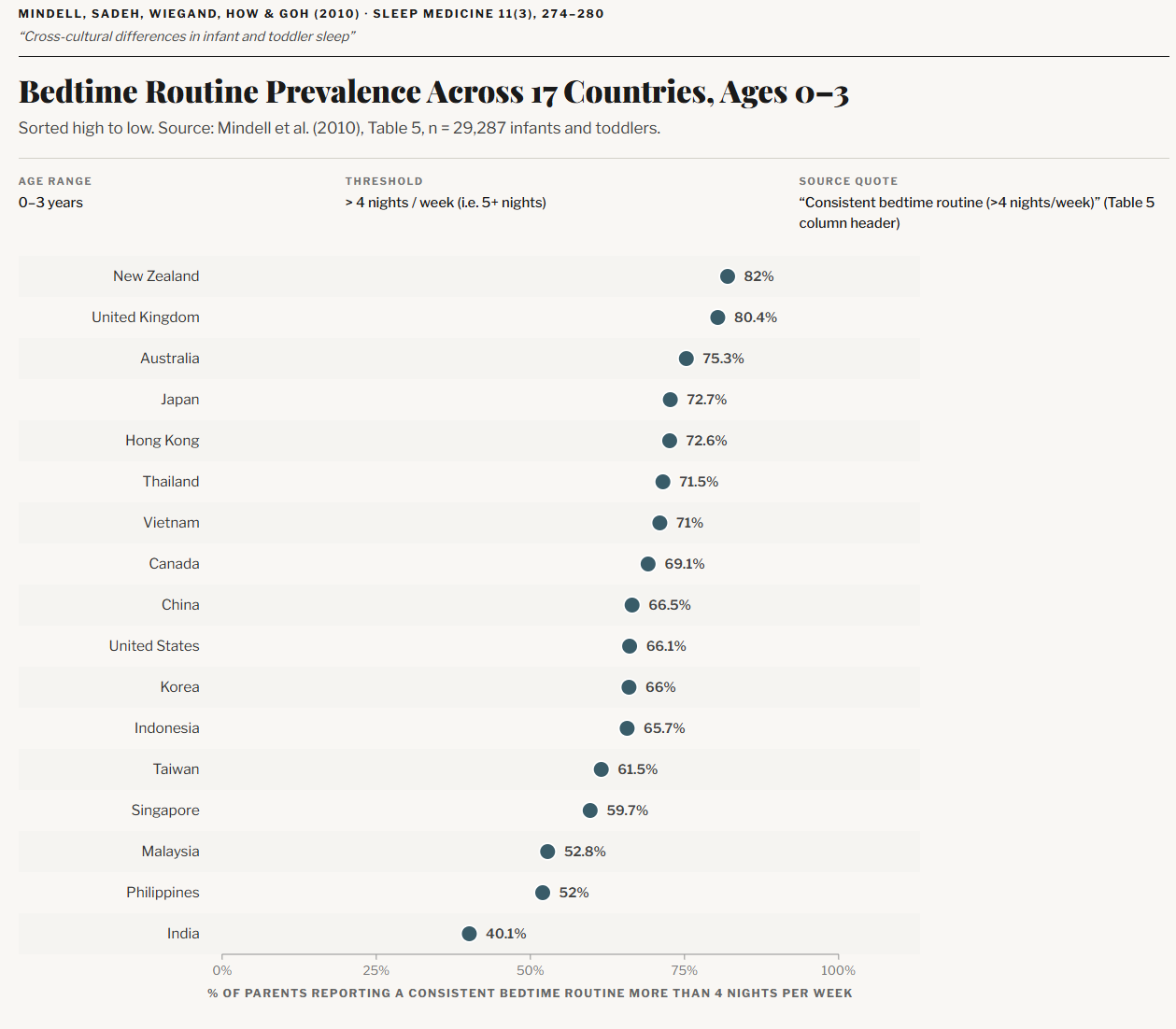
Above are data from Mindell et al. (2010), which were gathered through the Brief Infant Sleep Questionnaire from 29,287 parents of infants and toddlers (ages 0 to 36 months) across 17 countries.
Sorted from highest to lowest, the prevalence ranged from 82% in New Zealand to 40% in India. Said differently, in some countries roughly four out of five families reported a consistent bedtime routine, and, in others, only two out of five did. That reflects a 42-percentage-point spread within a single age range and a single survey item.
The three highest-prevalence predominantly Caucasian countries (New Zealand, the United Kingdom, and Australia) clustered at the top, all above 75%. Thailand and Vietnam came in at 71%, ahead of Canada and the United States. East Asia was split; Japan and Hong Kong sat at 73%, whereas Korea and Taiwan sat in the mid-60s and low-60s. Furthermore, India sat more than 40 percentage points below New Zealand, which was the largest within-study gap in this set of countries.
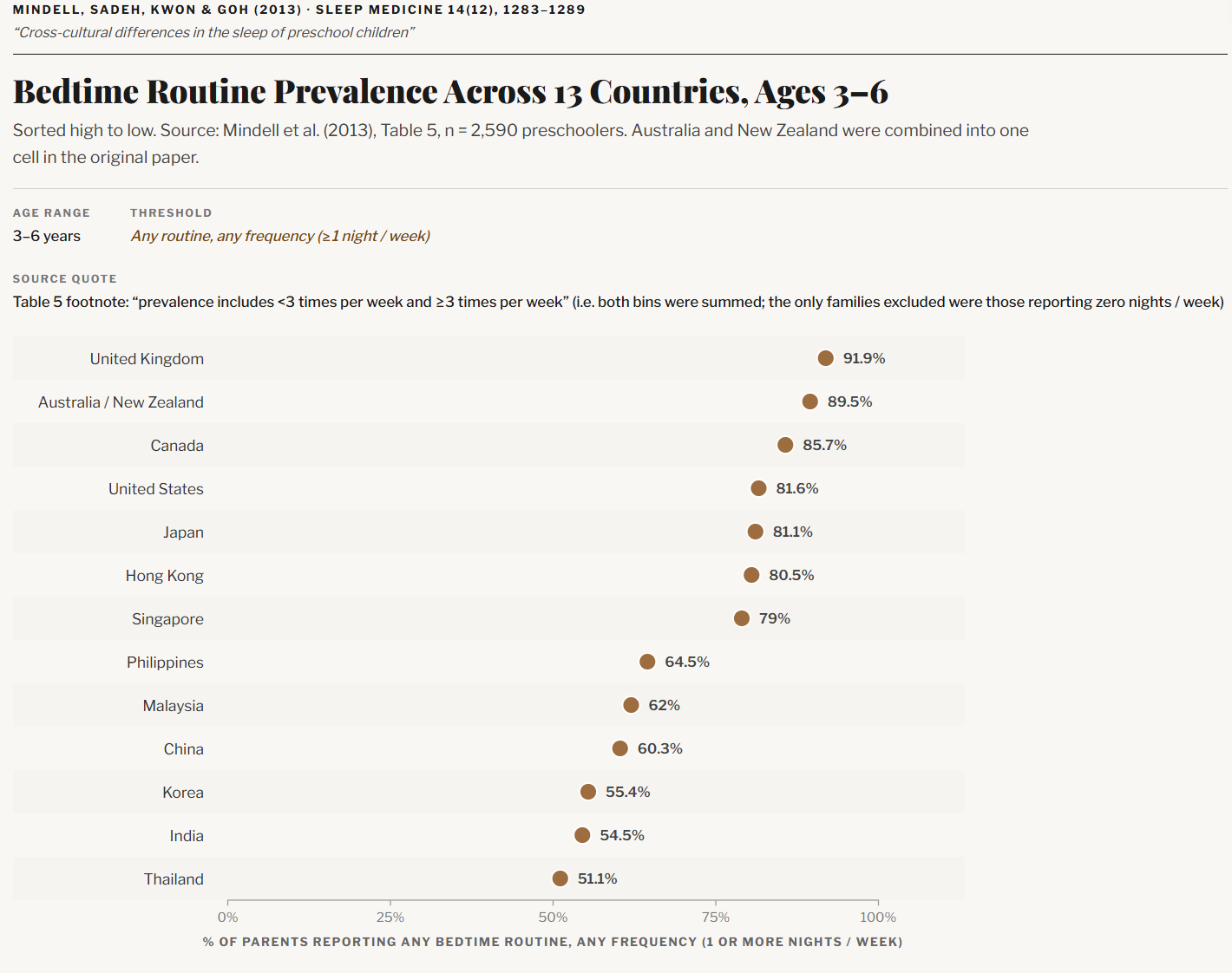
Read 2010 and 2013 side-by-side carefully. 2010 used a stricter bar (more than 4 nights/week, i.e. 5+) for infants and toddlers. 2013 used the loosest possible bar (any frequency) for preschoolers. The two numbers were not directly comparable.
Above are data from Mindell et al. (2013), which were gathered through a parent-report questionnaire from 2,590 preschoolers (ages 3 to 6) across 13 countries. Australia and New Zealand were combined within one cell in the original paper.
Sorted from highest to lowest, the prevalence ranged from 92% in the United Kingdom to 51% in Thailand. Said differently, in some countries roughly nine out of ten families reported any bedtime routine, and in others only about half did.
A few things to note. The threshold here was looser than Chart 1; any frequency of at least one night per week counted as ‘has a routine,’ so the prevalence numbers were higher overall. The four predominantly Caucasian rows (UK, Australia / New Zealand, Canada, United States) sat at the top, all between 82% and 92%; Japan, Hong Kong, and Singapore clustered next at 79% to 81%. China, Korea, India, and Thailand sat at the bottom, all below 61%. The largest single drop in this chart fell between Singapore at 79% and the Philippines at 65%, a 14.5-point gap.
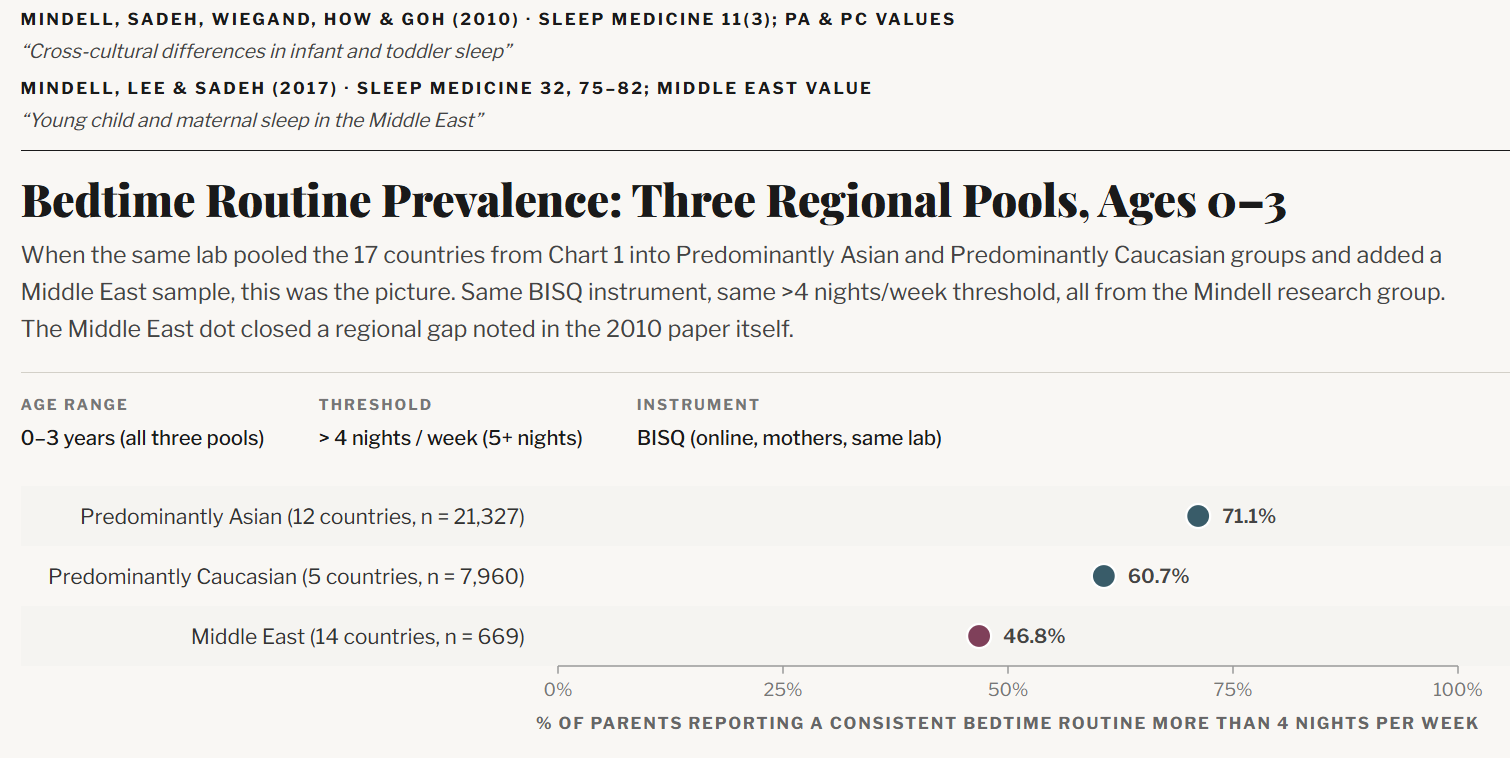
PA / PC values were from Mindell et al. (2010), Table 4; verified primary source. The ME value was from Mindell, Lee & Sadeh (2017), Sleep Medicine 32, 75–82, Table 2 (n = 669 infants & toddlers from 13 named Arabic-speaking countries plus a smaller pooled “other Arab countries” group; mean child age 15.9 mo). The 2017 paper reported its own PA/PC re-comparison values that appeared to swap PA and PC in the bedtime-routine row; we use Mindell 2010’s verified values for those rows. Mindell 2017 was funded by Johnson & Johnson; the 2010 paper had the same sponsor.
Above are data from Mindell et al. (2010) for the Predominantly Asian and Predominantly Caucasian pools, and from Mindell et al. (2017) for the Middle East pool. They used the same BISQ instrument, same >4 nights per week threshold, same lab. The infant and toddler sample across all three pools combined totaled 29,956.
The three regional pools landed at 71% (Predominantly Asian, n = 21,327), 61% (Predominantly Caucasian, n = 7,960), and 47% (Middle East, n = 669). Said differently, the Asian pool was about 24 percentage points higher than the Middle East pool, and the Caucasian pool sat in between. The Predominantly Asian and Predominantly Caucasian values came from the same paper as Chart 1; the Middle East value was added in the 2017 paper.
The Predominantly Caucasian pool of 61% sat below the top of Chart 1, where the three highest-prevalence countries in that pool (New Zealand, the United Kingdom, and Australia) all sat above 75%; the pool also included the United States (66%) and Canada (69%), which came in lower. The Middle East pool combined 13 named Arabic-speaking countries plus a smaller pooled ‘other Arab countries’ group; mean child age was 15.9 months.
Take-home-point for practice
Develop a culturally sensitive perception and intervention approach. For instance, across these 17 countries, “normal sleep” looked very different. A clinician’s default plan as a starting point should be responsive to what the family considers normal, not the other way around.