

Cultural Differences in Pediatric Sleep Between Predominantly Asian and Predominantly Caucasian Countries (Birth to 6)
Two Notable Co-Authored Studies by Jodi Mindell and Colleagues

Editor’s Note: I co-authored “Pediatric Sleep: A Behavioral Account” with Dr. Nicole Rodriguez for the second edition of Madden and DiGennaro-Reed’s APA Handbook of Behavior Analysis (in press), and I am writing Sleepy Star (in development) with Dr. Derek Reed, which is a children’s book as a bedtime aid for parents. Between the chapter, the book, and my clinical work with families, I have been reading scientific articles and popular-press pieces about pediatric sleep. Some of these posts re-imagine data from published studies by creating new graphical depictions to tell the data-based stories.
We are using substack as a way to reach people through email so we are not beholden to algorithmic changes on any social-media platform. Please subscribe.
A four-year-old sleeps in their parents’ bed. Is that a sleep concern? It is essential that we talk with each family because there are notable cultural differences in where children sleep, when they go to bed, when they wake up, and if they nap.
In the United States, about three-quarters of preschoolers sleep in their own room. In China, fewer than 7% do (Mindell et al., 2013).
In a previous post, I looked at parent-reported sleep durations of children across four countries (Iglowstein and colleagues, 2003, Switzerland; Schlarb and colleagues, 2015, Germany; Cespedes and colleagues, 2014, USA; Li and colleagues, 2013, China). Children’s total sleep durations varied considerably depending on where the children were raised.
In this post, I am looking at the larger cross-cultural sleep surveys. The two papers led by Dr. Jodi Mindell and colleagues (2010, 2013) collected parent-reported sleep variables from 29,287 infants and toddlers (ages 0 to 36 months) across 17 countries, and from 2,590 preschoolers (ages 3 to 6 years) across 13 of those same countries. The two studies used the same questionnaire framework, which allowed us to look at different aspects of sleep across the first six years.
The four figures below were built from the data tables and graphs published in the two Mindell papers. I plotted values from both studies on the same axes so the developmental and cross-cultural patterns can be read across the first six years on the same page. The exact figures shown here do not appear in either source paper.
One reason these comparisons matter for clinical practice and for parents was stated by Mindell et al. (2006):
“In addition, culturally-based values and beliefs regarding the meaning, importance, and role of sleep in daily life, as well as culturally-based differences in sleep practices (e.g., sleeping space and environment, solitary sleep vs. co-sleeping, use of transitional objects) have a profound effect not only on how a parent defines a sleep ‘problem’ but on the relative acceptability of various treatment strategies.” Mindell et al., 2006, p. 1264
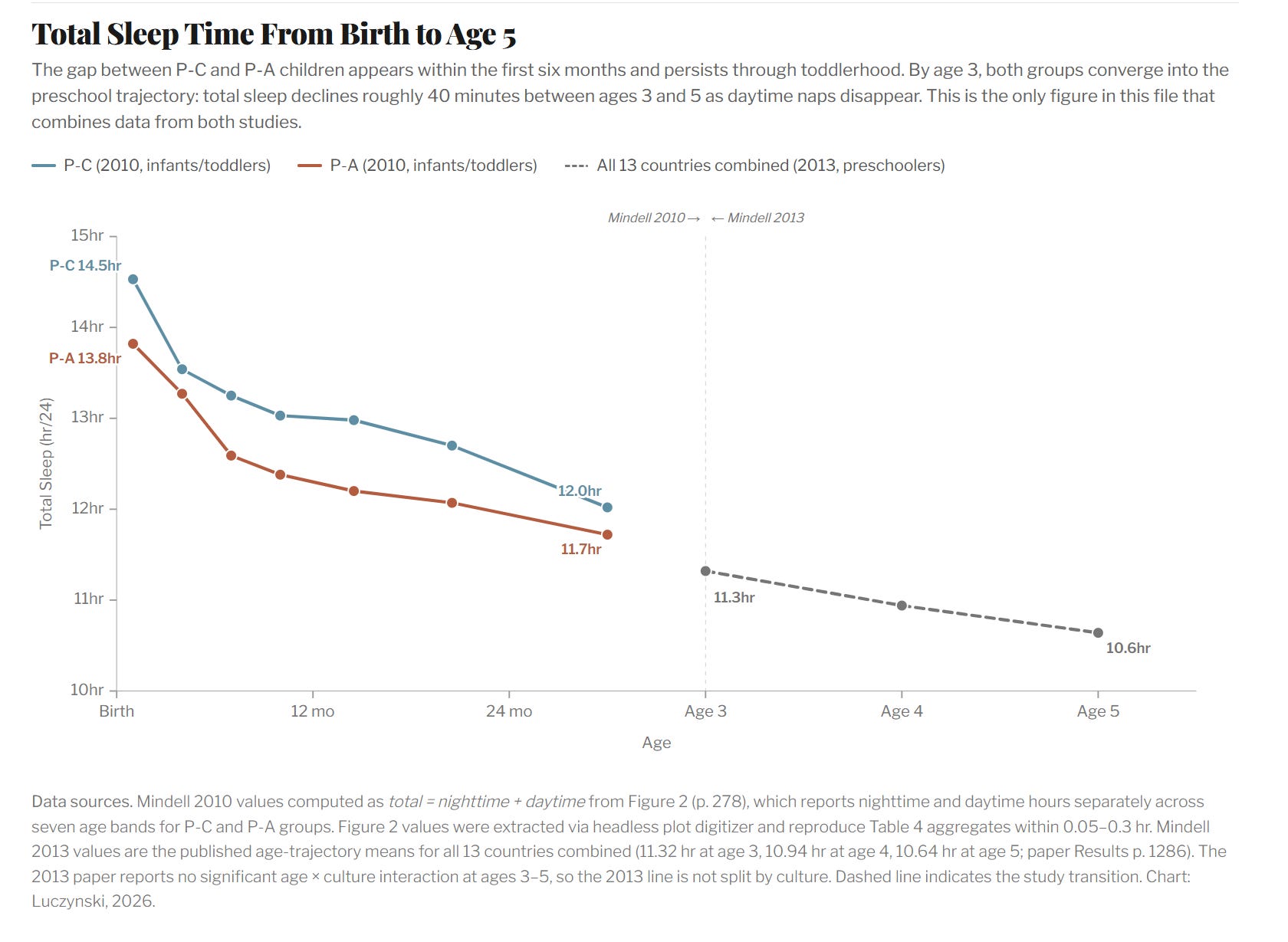
Data in the figure above are from the two Mindell studies and are plotted across the first six years. The cross-cultural gap in total sleep was already present in infancy. Mindell et al. (2010) reported an aggregate difference of 0.71 hours, or about 43 minutes, between predominantly Caucasian and predominantly Asian infants and toddlers, with the predominantly Caucasian group sleeping more.
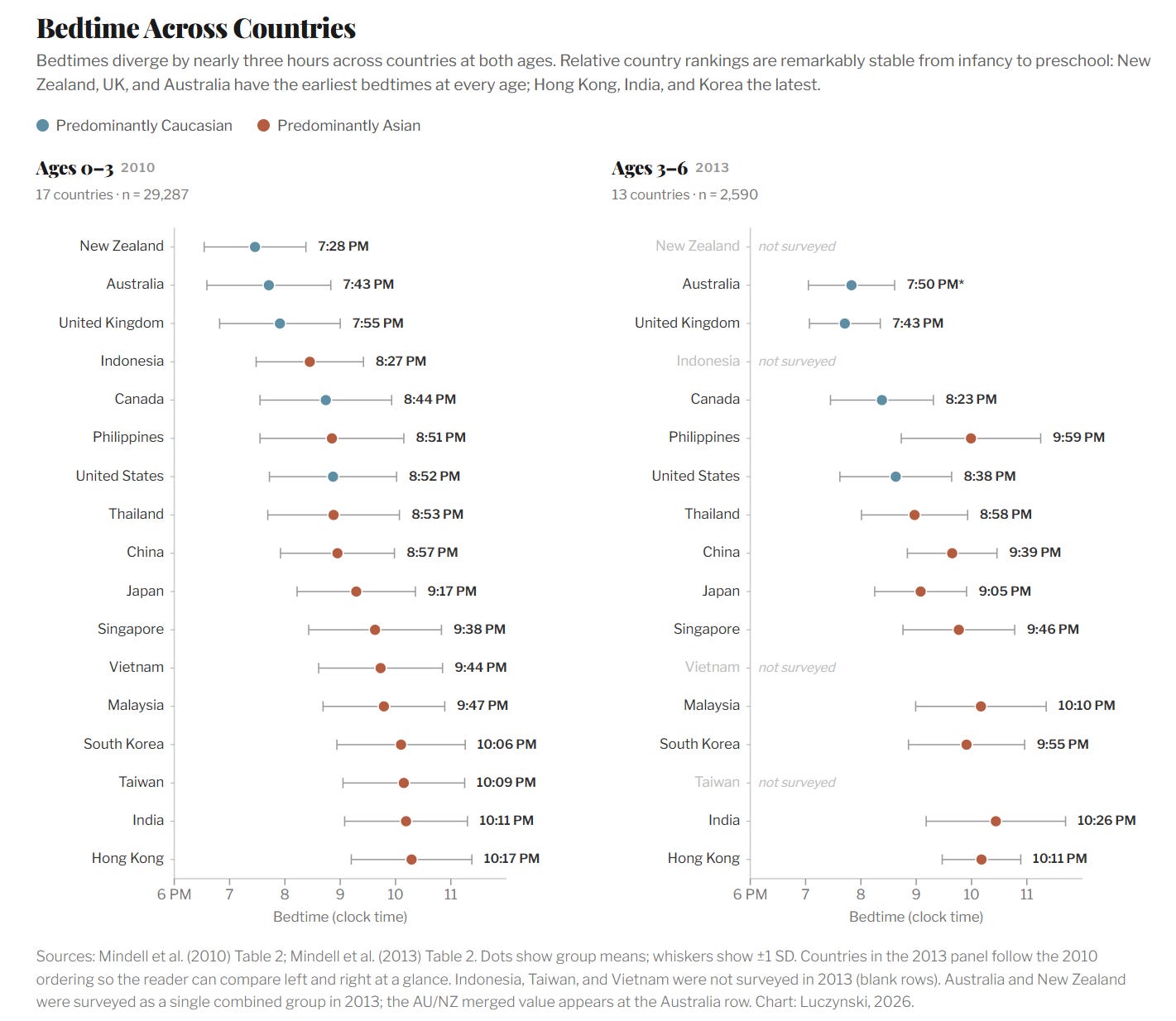
Data in the above figure represent bedtimes for 17 countries at infant and toddler ages on the left column and 13 countries at preschool ages on the right column. Bedtimes varied across countries by almost 3 hours at both ages, but there were notable degrees of variability for each country. New Zealand, the United Kingdom, and Australia had the earliest group means at every age (before 8:00 PM). India and Hong Kong have the latest at both ages (after 10:00 PM); South Korea is among the latest at infant and toddler ages but slightly earlier at preschool age (about 9:55 PM). The country rankings, for the most part, remained stable from infancy through preschool.
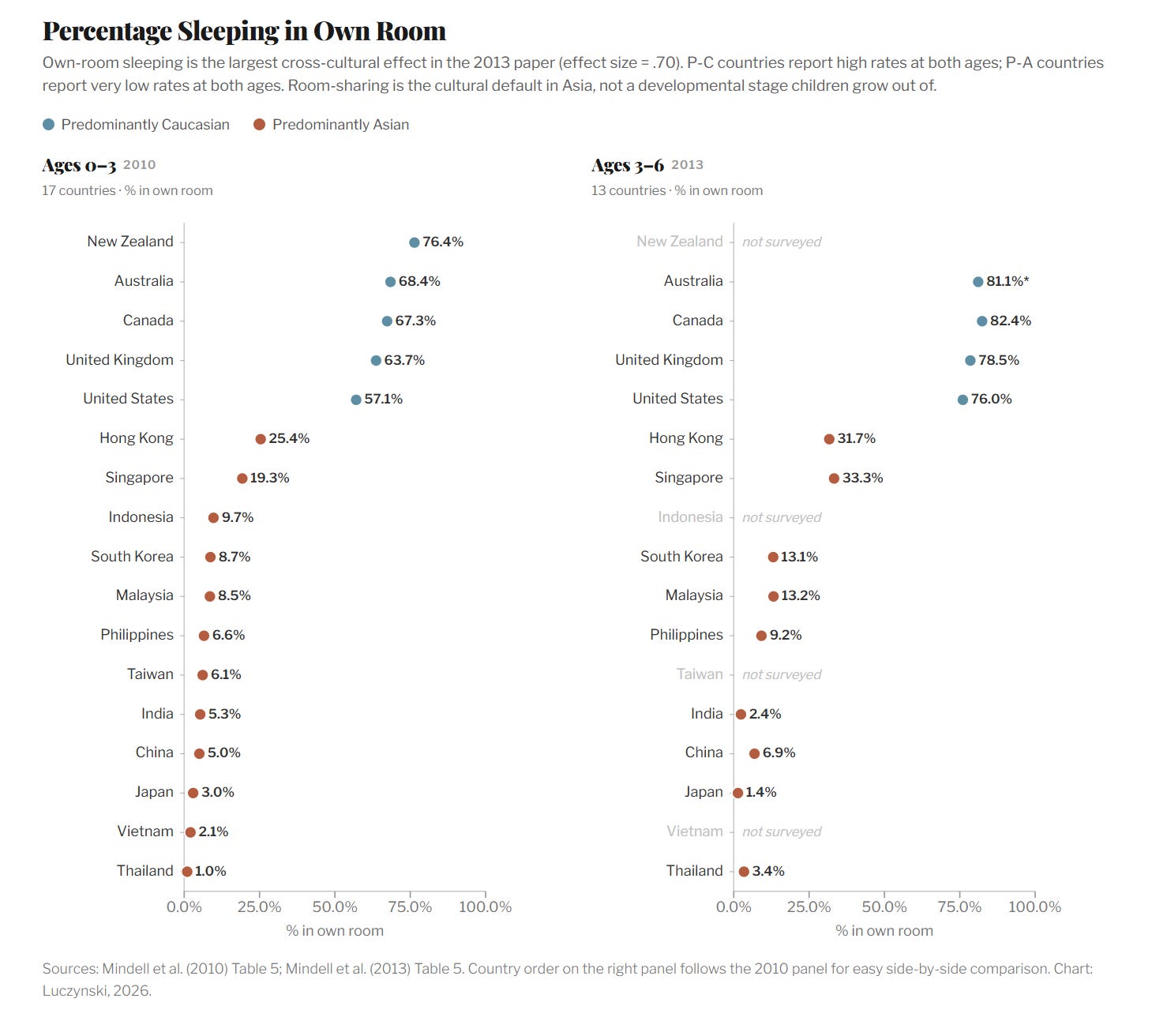
Data in the above figure represent the percentage of children who sleep in their own room across countries. This was the largest cross-cultural effect in either Mindell paper (effect size φ = .70 in the 2013 paper). In countries grouped as predominantly Caucasian, most children slept in their own room from infancy onward. In countries grouped as predominantly Asian, the percentage of families for which a child slept in their own-room remained low at both age groups and remained in single digits in several countries through age 6. As such, what counts as "on track" for sleeping in their own room is a cultural question more than a developmental one. This is critical as we work with families and schools on improving pediatric sleep.
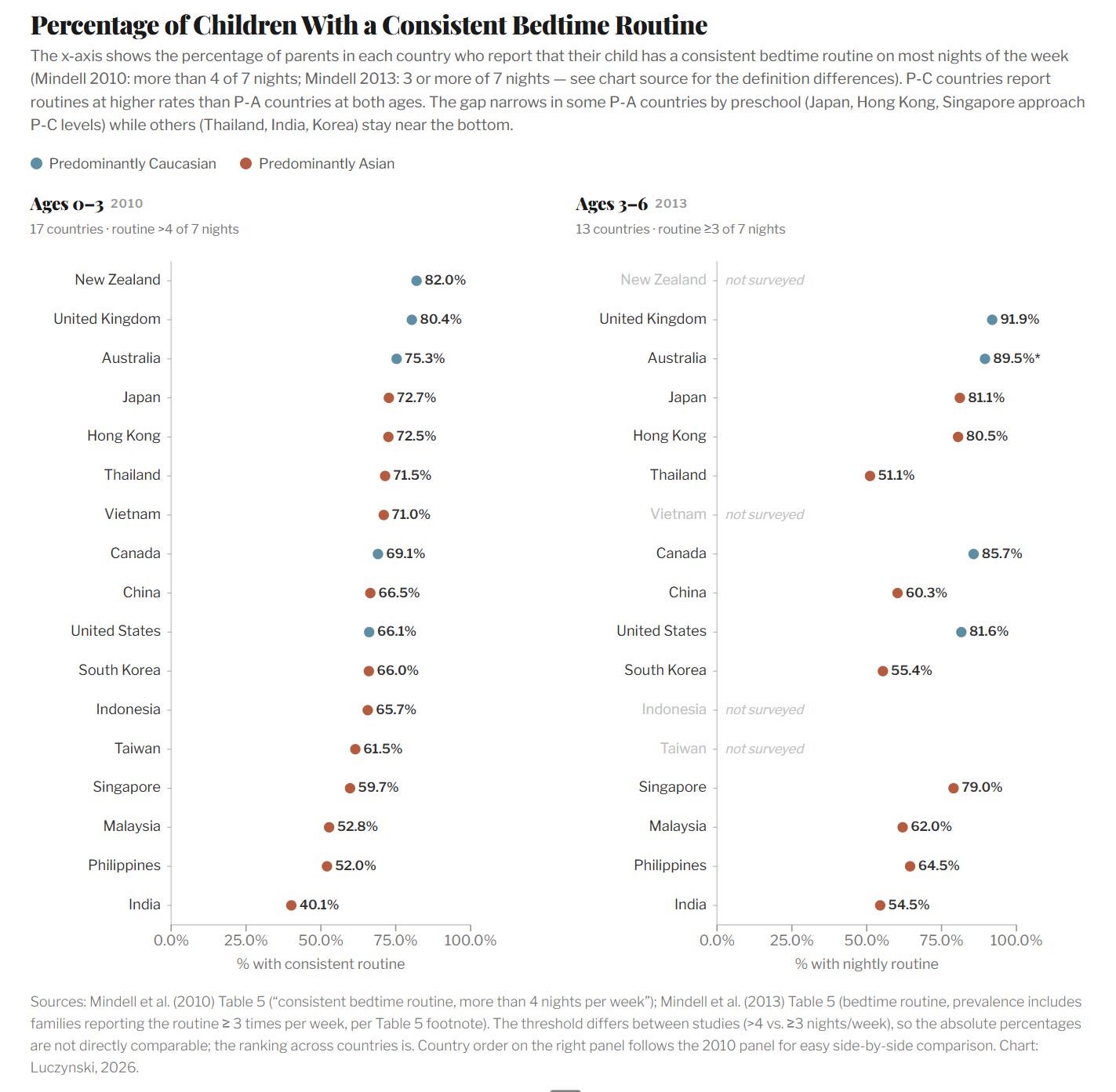
Data in the above figure represent the percentage of parents reporting a consistent bedtime routine on most nights. The two papers used different thresholds (Mindell et al., 2010 used “more than 4 nights per week” and Mindell et al., 2013 used “3 or more nights per week”). Countries grouped as predominantly Caucasian reported consistent routines at higher percentages than countries grouped as predominantly Asian.
Where a child sleeps and when a child goes to bed differ across the world. What looks like a problem in one country is a cultural expectation in another one. This is why every discussion about a potential sleep concern requires listening to what is valued by the family at the start and throughout the assessment and treatment process.
References
Mindell, J. A., Kuhn, B., Lewin, D. S., Meltzer, L. J., & Sadeh, A. (2006). Behavioral treatment of bedtime problems and night wakings in infants and young children. Sleep, 29(10), 1263–1276. https://doi.org/10.1093/sleep/29.10.1263
Mindell, J. A., Sadeh, A., Wiegand, B., How, T. H., & Goh, D. Y. T. (2010). Cross-cultural differences in infant and toddler sleep. Sleep Medicine, 11(3), 274–280. https://doi.org/10.1016/j.sleep.2009.04.012
Mindell, J. A., Sadeh, A., Kwon, R., & Goh, D. Y. T. (2013). Cross-cultural differences in the sleep of preschool children. Sleep Medicine, 14(12), 1283–1289. https://doi.org/10.1016/j.sleep.2013.09.002